


New CADC Procurement Guide For Diving Services Now Available
By CADC Admin ~ July 23rd, 2026. Filed under: Latest Diving News, Press Release, Safety, Standards and Regulations.
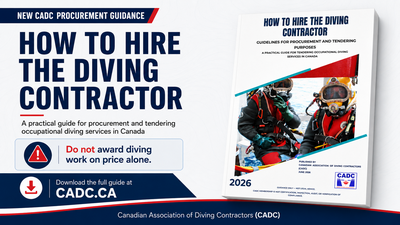
You’re Hiring a Diving Contractor. Are You Asking the Right Questions?
Commercial diving is not just another line item in a tender?
It is occupational work carried out underwater, often in poor visibility, cold water, current, confined access, or around infrastructure that was never designed with a diver in mind. When the work is scoped badly, the problem does not start in the water. It often starts much earlier — in the wording of the RFQ.
That is why the Canadian Association of Diving Contractors has released How to Hire the Diving Contractor: Guidelines for Procurement and Tendering Purposes.
The guide is written for the people who hire diving services, write tender documents, review bids, insure the work, or manage the project. It explains what should be asked before the job is awarded and what should be checked before anyone enters the water.
A low bid is not a bargain if the contractor cannot prove competency, proper supervision, suitable insurance, safe work planning, and emergency readiness. The guide gives procurement staff practical wording, checklists, red flags, and review tools to help separate a proper commercial diving operation from a risky one.
It also addresses a common misunderstanding: recreational scuba training is not a substitute for occupational diving competency. Commercial diving carries different responsibilities, different hazards, and different legal expectations.
This is not a complicated message. If you are hiring diving services, the tender should require more than a price. It should require proof that the work will be done safely, competently, and in compliance with applicable requirements.
The guide is available now at CADC.CA. DOWNLOAD HERE
Download it, read it, and share it with anyone involved in hiring or specifying commercial diving work.
Good tender wording protects the project. More importantly, it protects the people in the water.